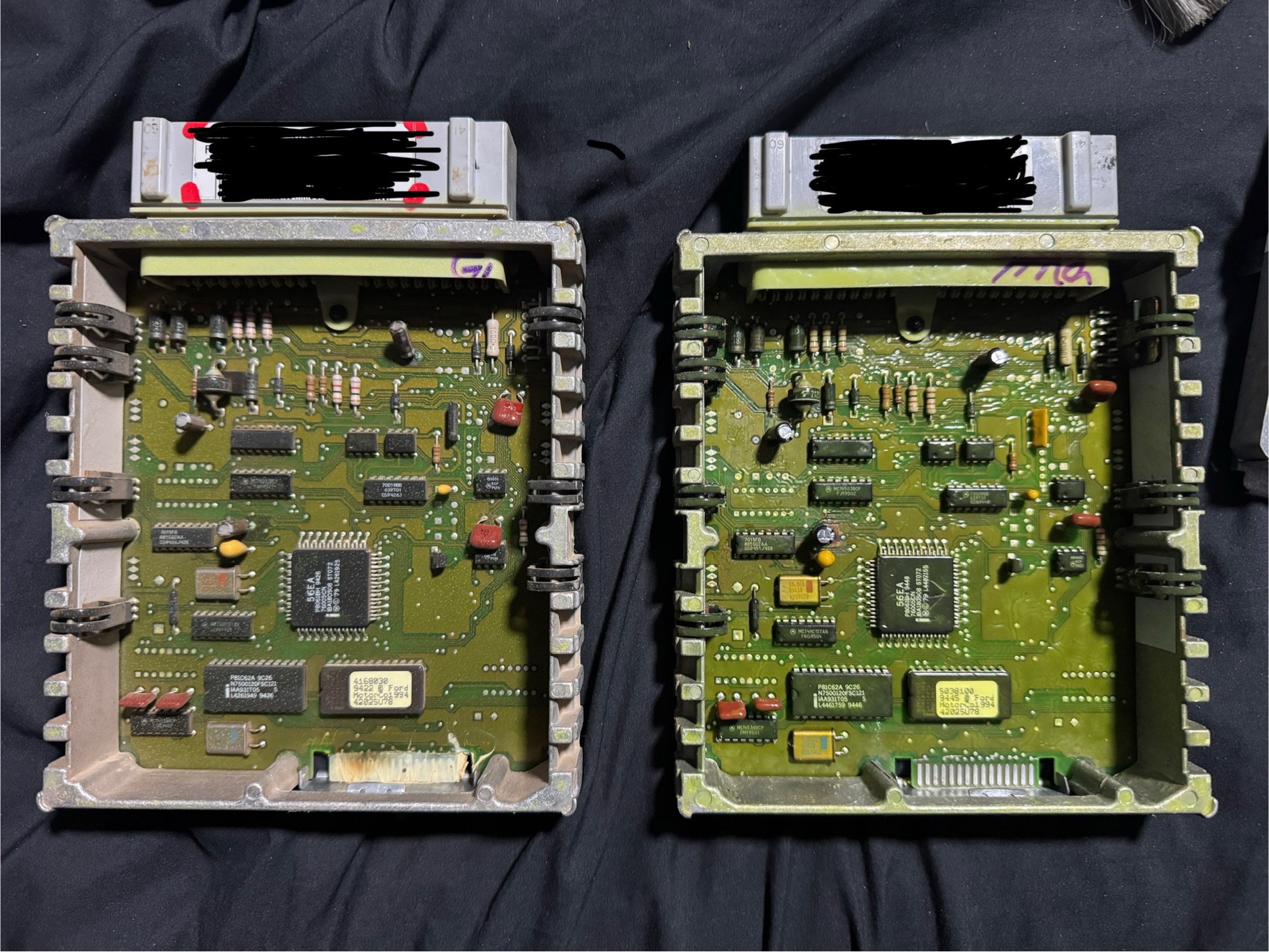
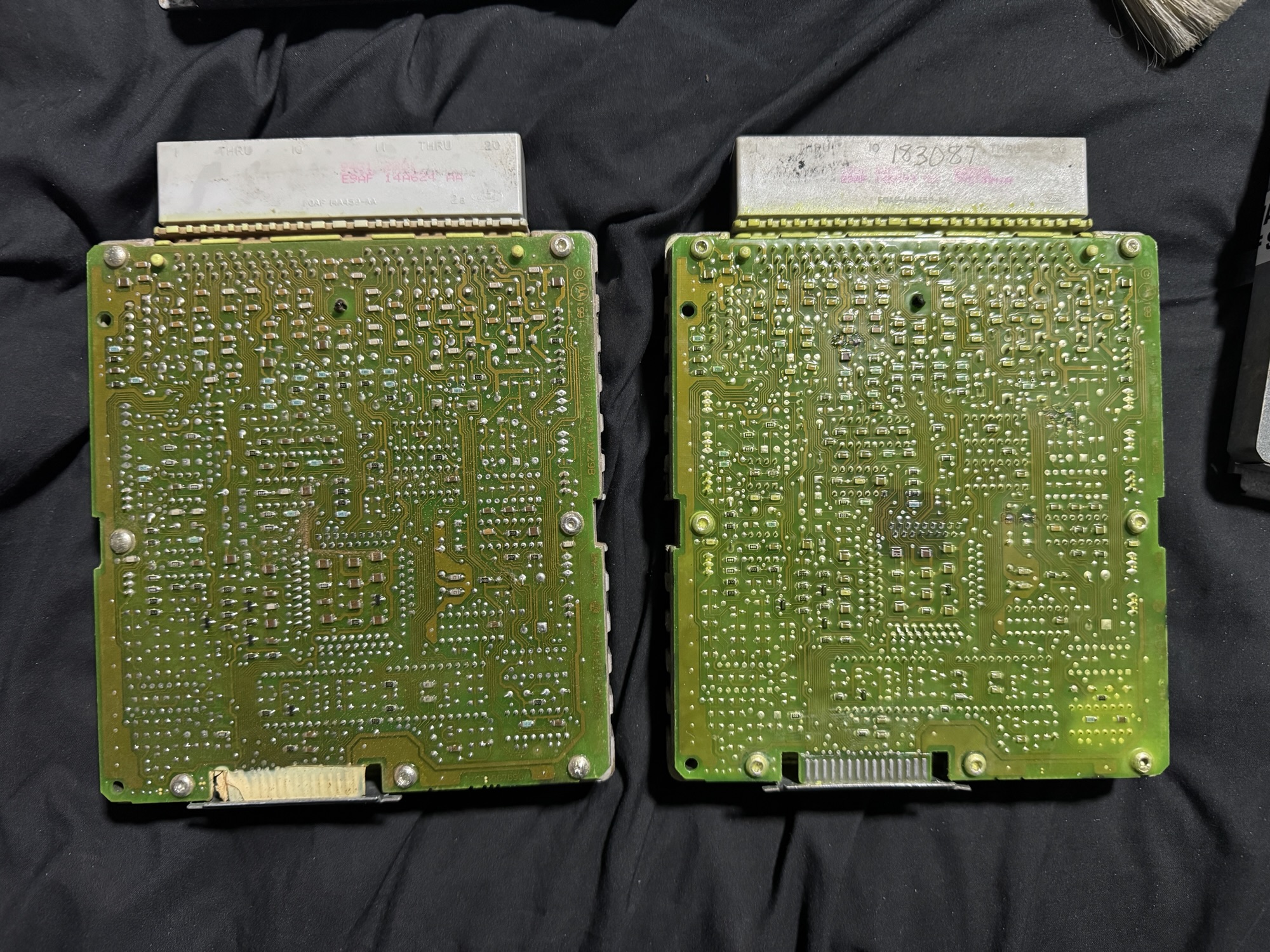
A customer brought in two PCMs (powertrain control modules, the engine computer) for a 1995 Ford truck. One was the truck’s original, and its factory electrolytic capacitors had leaked onto the board. The other was a rebuilt unit fitted with newer capacitors. The request was specific: move the capacitors from the rebuilt PCM into the original. Doing that properly also meant repairing what the leak had done to the board.
Why capacitors matter in a 30-year-old engine computer
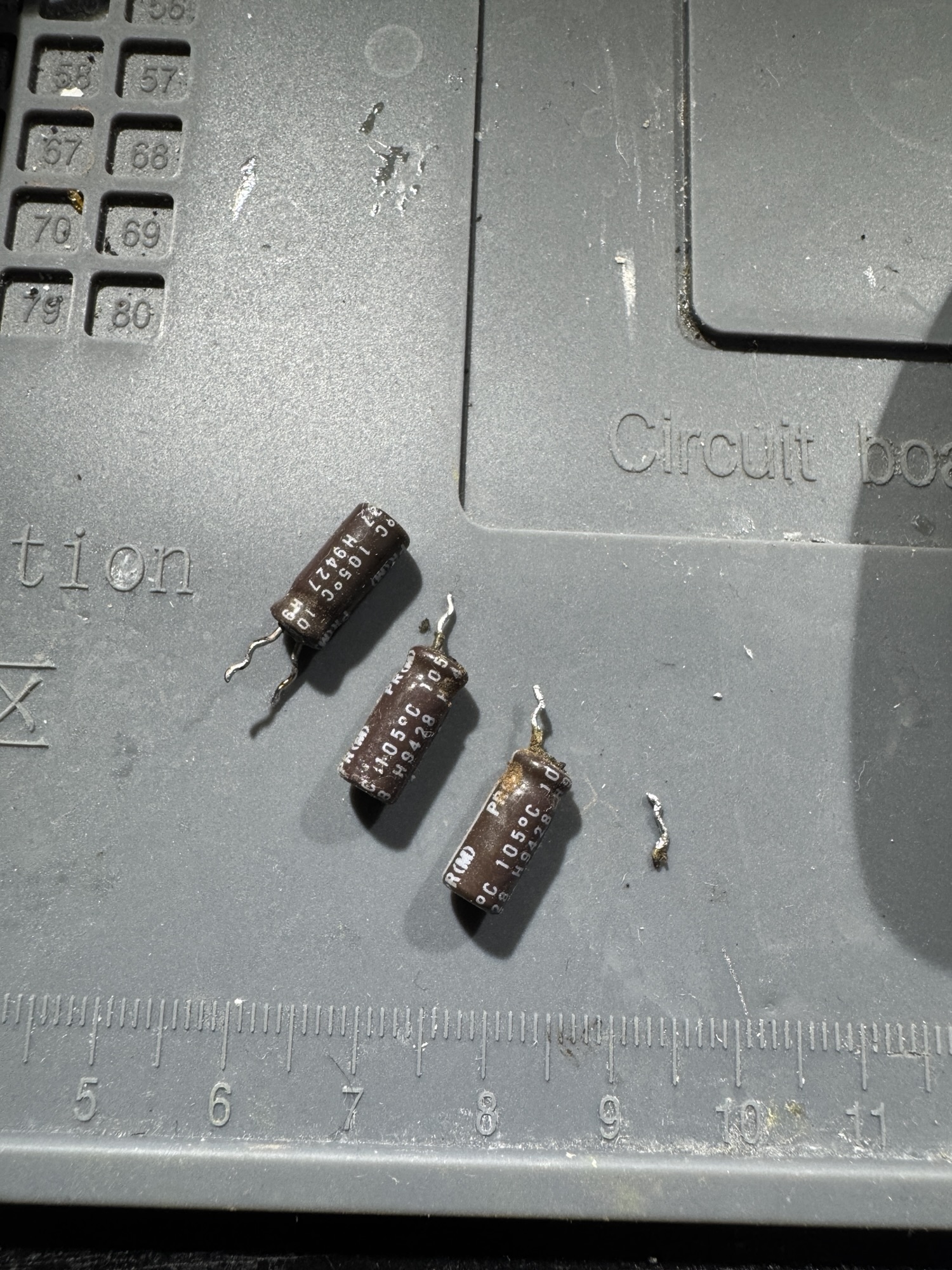
An electrolytic capacitor is a small can filled with a liquid electrolyte, sealed with a rubber plug at the bottom where the legs come out. After decades of engine-bay heat cycles the seal hardens and the electrolyte seeps out, right at the base of the part and onto the board. This PCM had three of them, all Nichicon 105°C parts with 1994 date codes: original equipment, and 30-plus years old.
Losing electrolyte is bad for the capacitor, but the leak itself does more damage. Electrolyte is corrosive and electrically conductive. It works its way under the solder mask, eats the copper traces and pads underneath, and leaves a residue that can leak current between traces that are supposed to be isolated. Left alone, it keeps spreading, and on a board this dense it doesn’t have far to go before it reaches something that matters.
What the leak did to this board
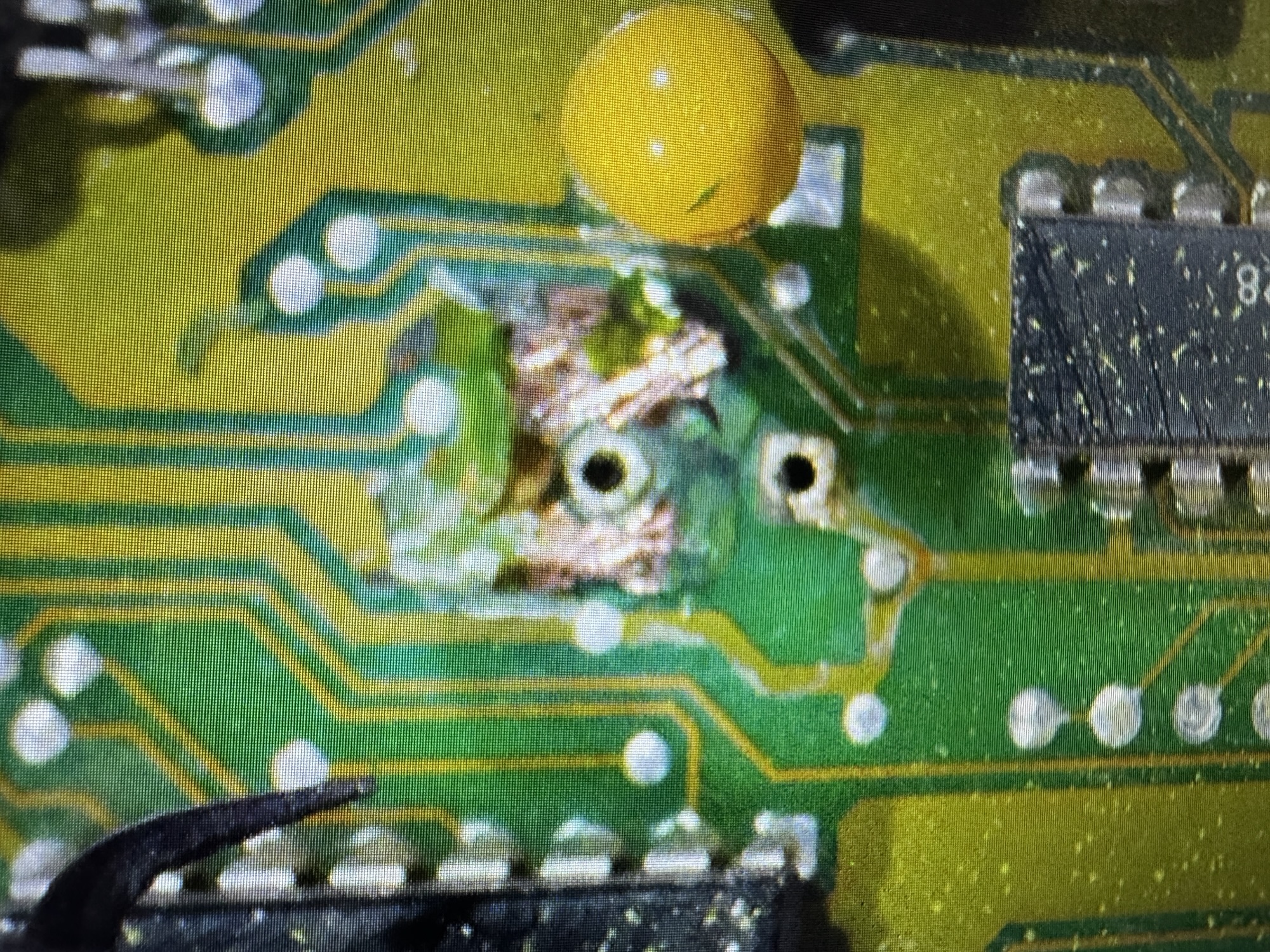
The electrolyte had spread out from under the capacitors and corroded the copper around them. It had also corroded all the way through the legs of two of the capacitors, so those two were no longer attached to anything but the corrosion itself.

Getting the old capacitors out
Ford coated these boards in conformal coating, a clear protective layer over the whole assembly. It keeps moisture off the board, and it also sits on top of every solder joint, so the first step at each joint is melting through the coating to get to the solder underneath.
With the bad capacitors out, I scraped the dried electrolyte off the board, along with the solder mask it had lifted and corroded. That exposed how far the damage went.

Moving the replacement capacitors
The replacement capacitors came off the second PCM. To get them out without cooking them, I used low-melt solder. It’s an alloy that mixes into the existing joint and drops its melting point well below normal, so the joint stays liquid at a much lower temperature and the part lifts out without a fight. That means less heat into the capacitor, which matters because heat is what wears electrolytics out, and less stress on the board’s pads.
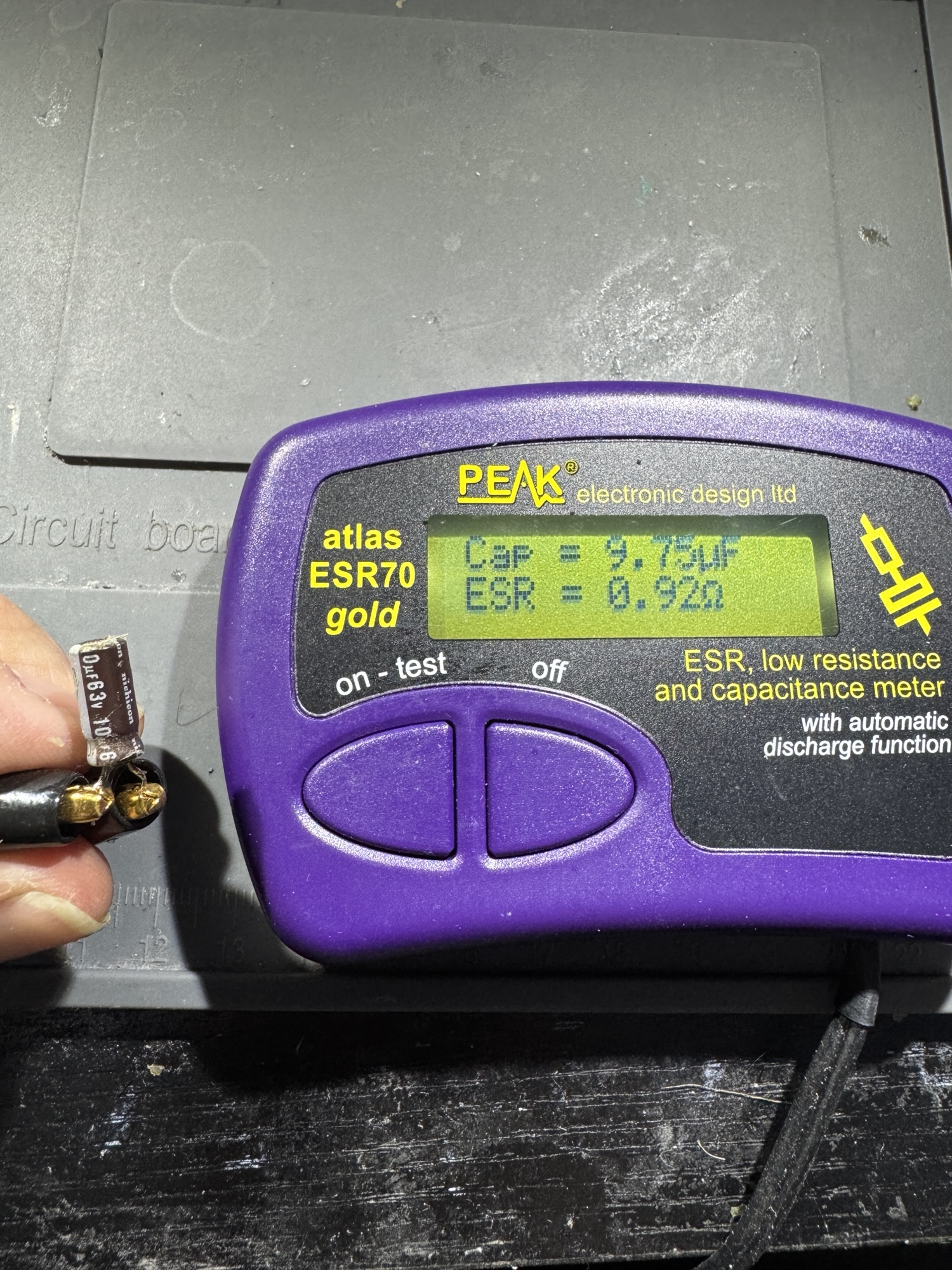
A capacitor pulled from another board isn’t assumed good. Each of the three was measured on a Peak Atlas ESR70 for both capacitance and ESR (equivalent series resistance) before it went in. Both numbers matter: a capacitor can still read the right capacitance while its ESR has climbed, and a high-ESR capacitor doesn’t filter the way the circuit needs it to. All three checked good: capacitance within tolerance and ESR under 1 Ω.
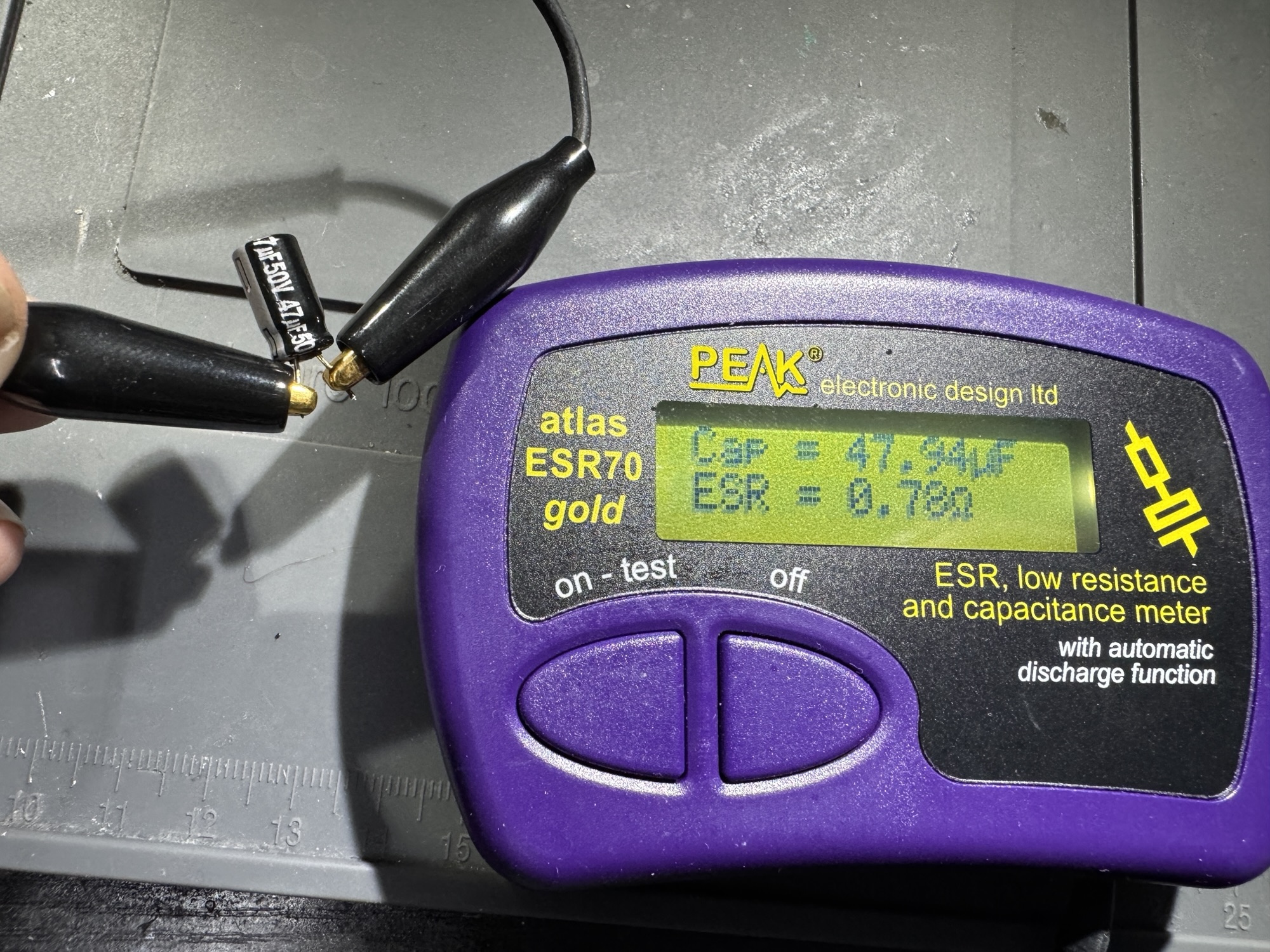
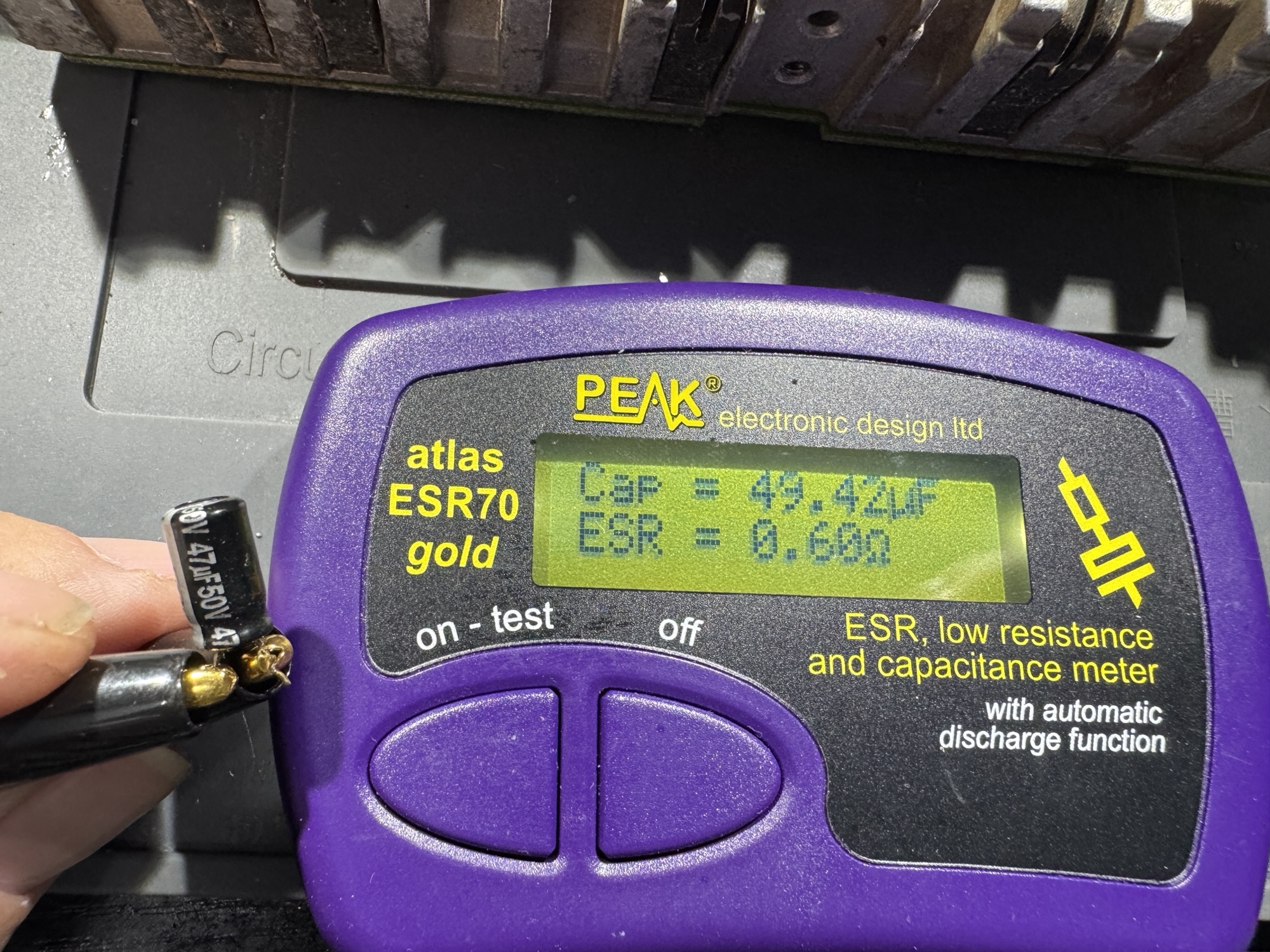
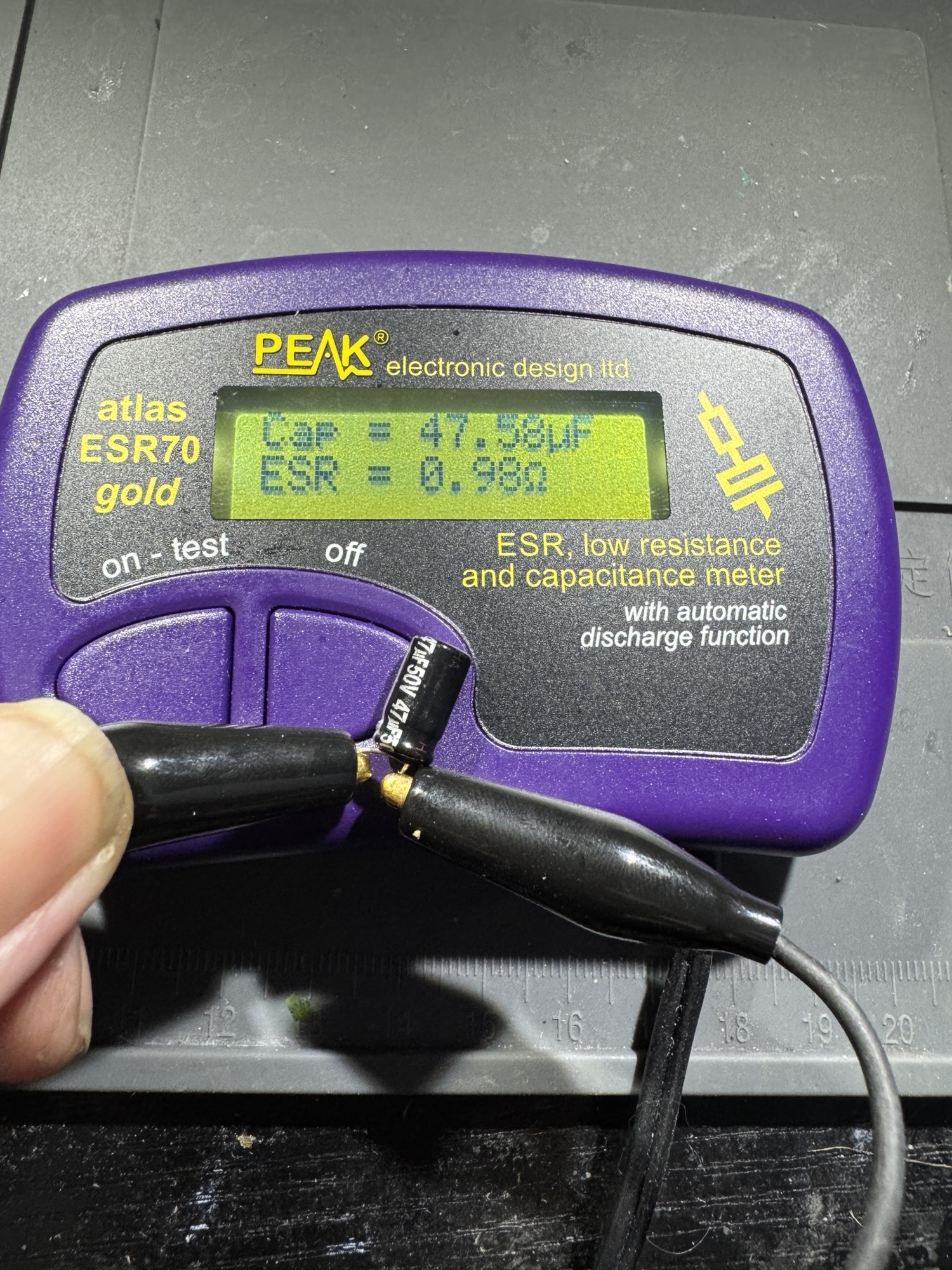
Of the three originals, two had clearly failed: they’re the ones with the legs corroded through. The third, the 10 µF, still had legs to clip onto, and it still measured good: 9.75 µF at 0.92 Ω. All three were replaced anyway. They’re the same age and the same construction, and it was only a matter of time before the third did what the other two already had.
Repairing and resealing the board
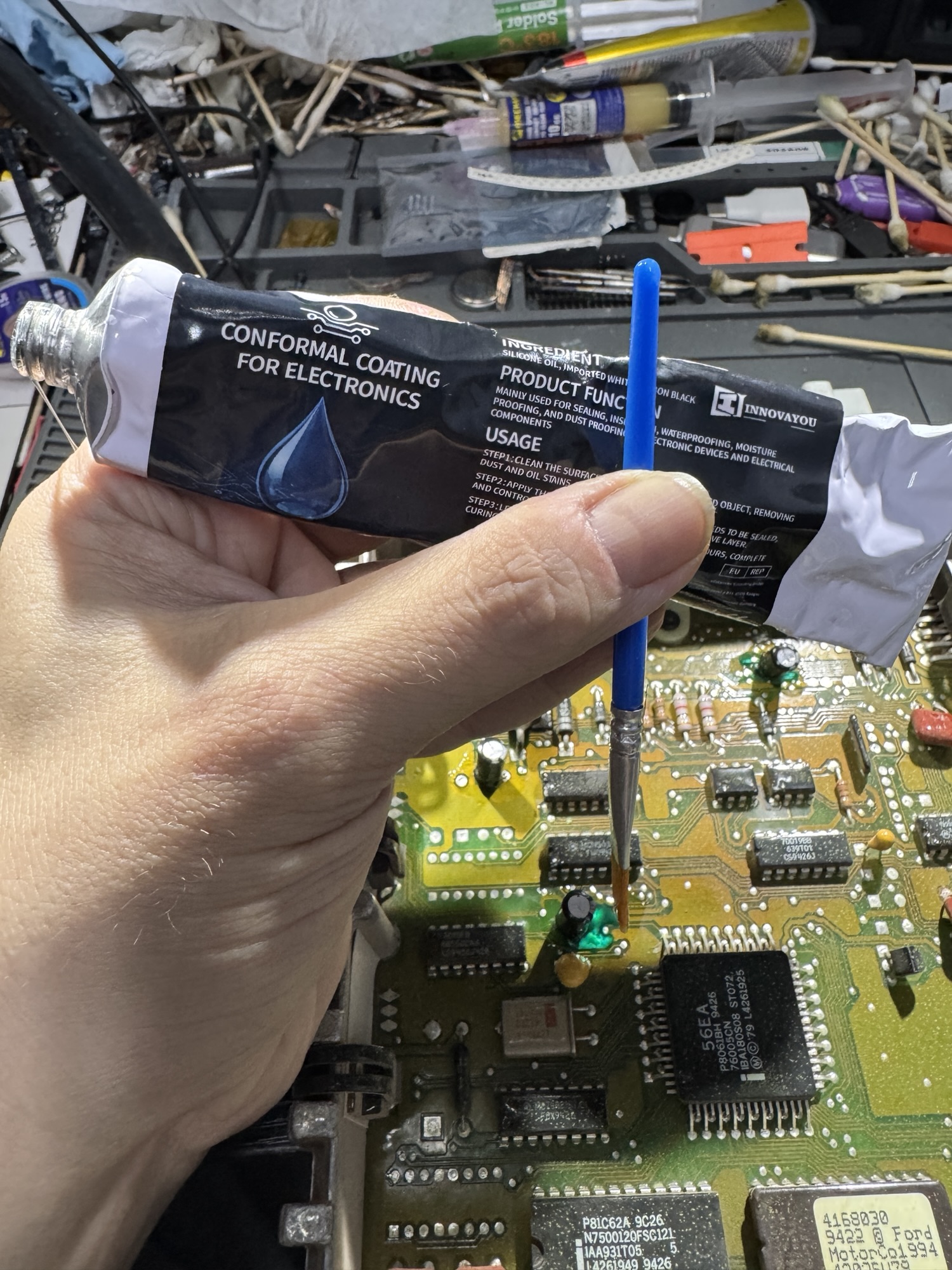
With the corrosion scraped back to clean copper, I rebuilt the damaged traces with solder bridges and tinned the rest of the exposed copper, so none of it is left bare to corrode again, then soldered in the replacement capacitors. On top of that went UV-curing solder mask, the green layer in the photos, cured under UV light. The mask insulates the repair and seals it.
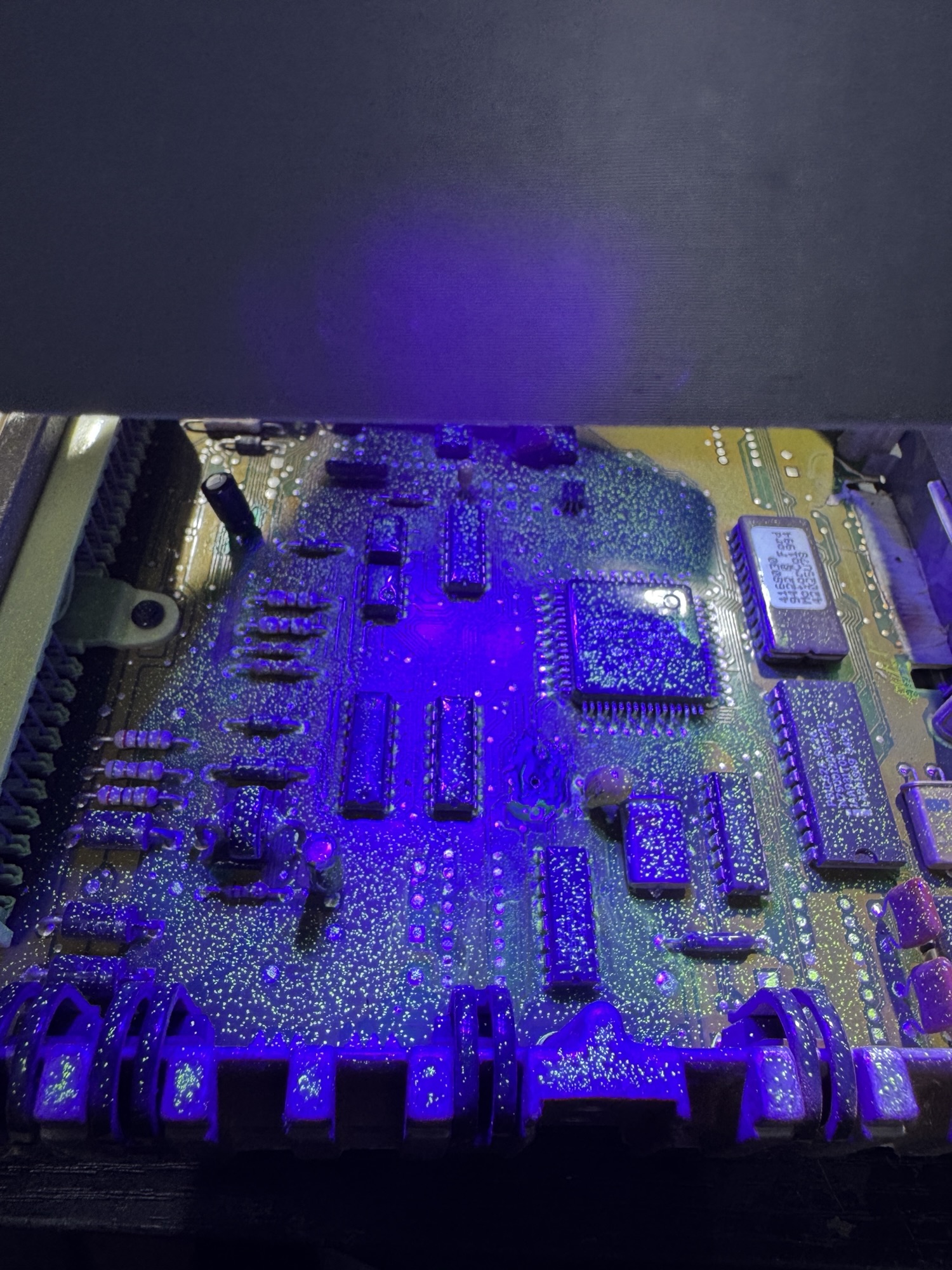
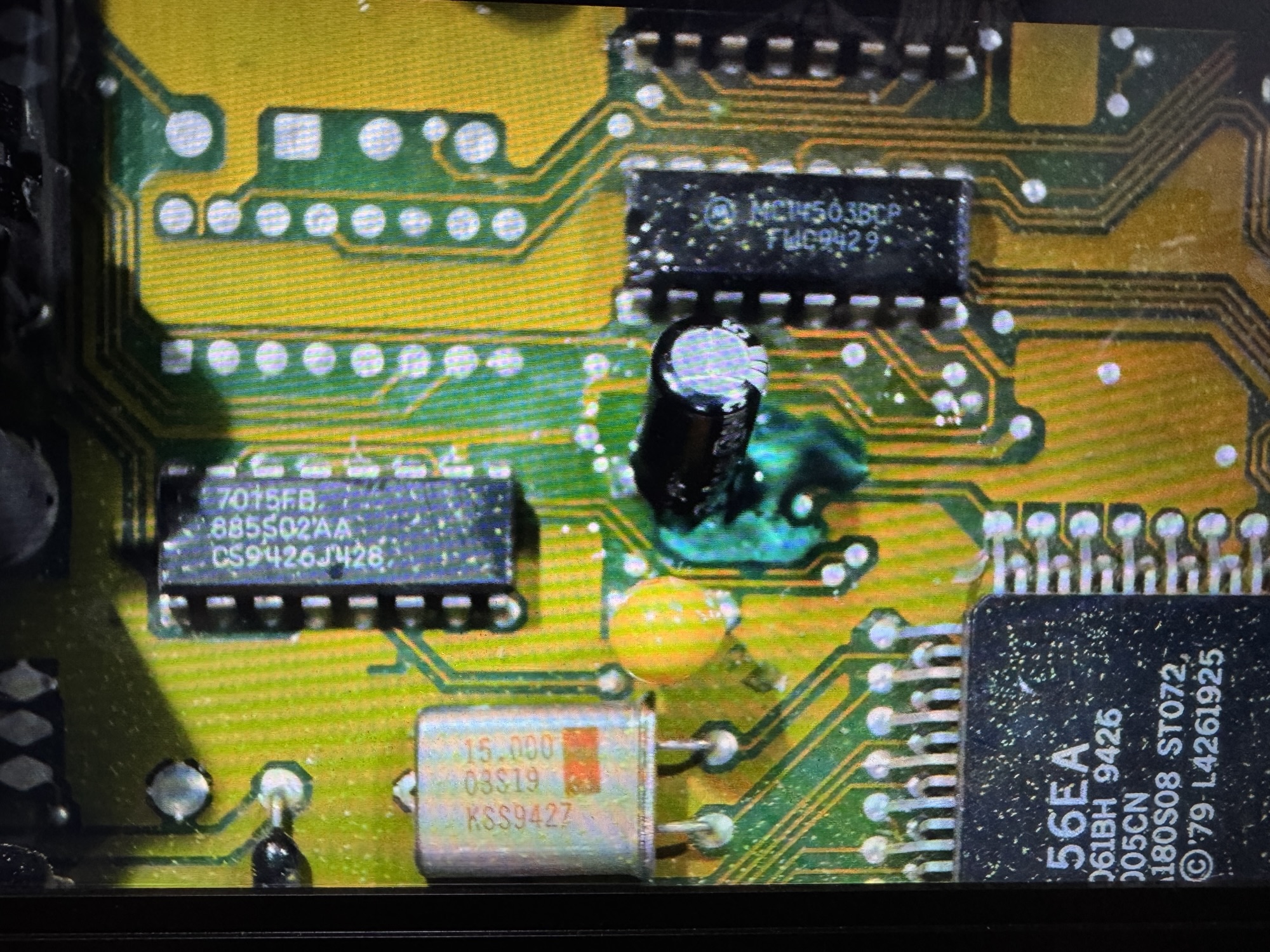
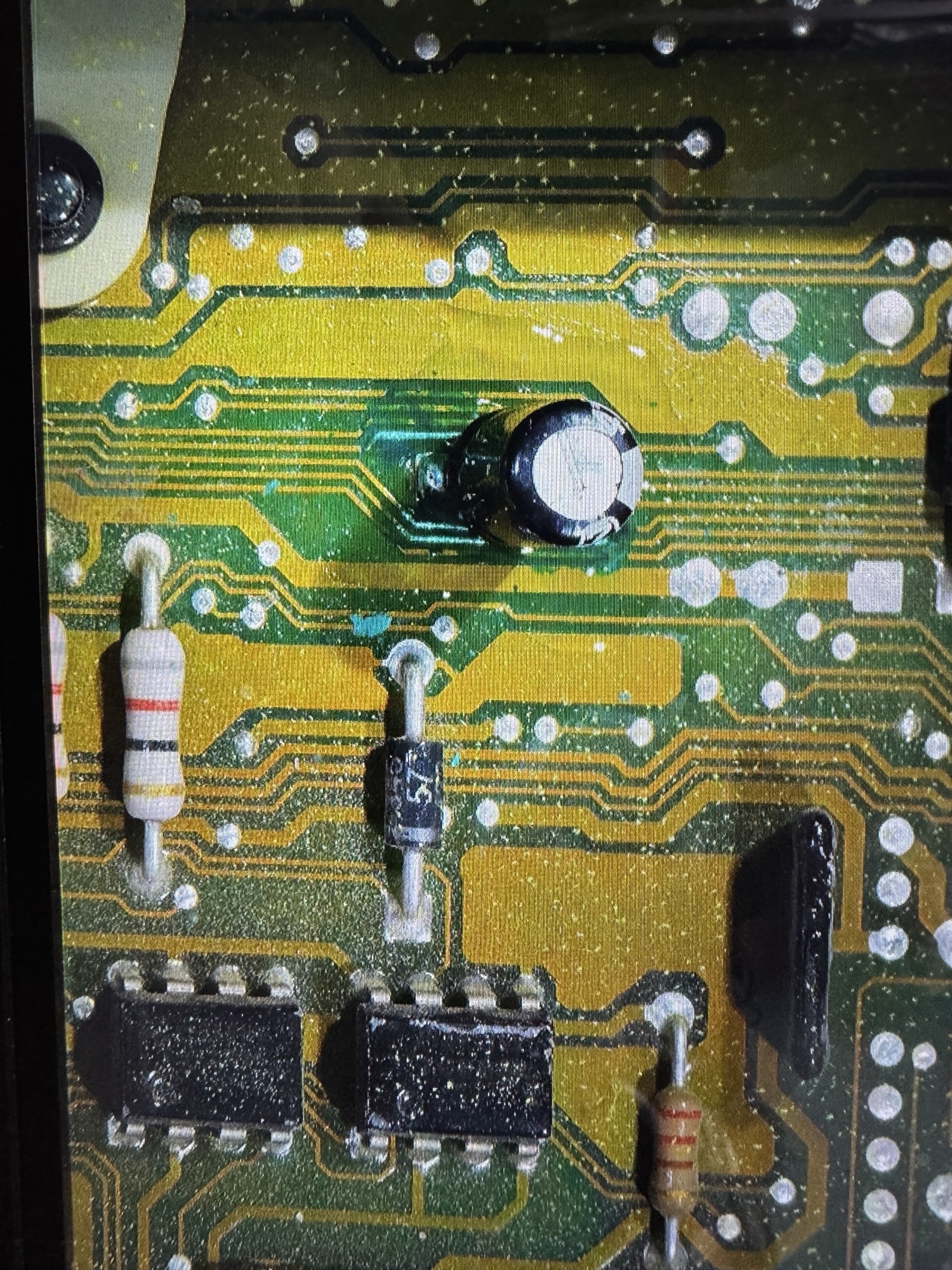
The last step was putting back the protection I’d had to remove. Everywhere the factory conformal coating had been melted through or scraped away, on both sides of the board, got fresh conformal coating brushed on.

The takeaway
The original capacitors in any 1990s engine computer are past their service life by now, and once they leak, the damage keeps spreading for as long as the electrolyte stays on the board. Caught early, it’s a capacitor replacement. Left alone, it becomes trace repair, and eventually a board that can’t be saved. This one got the capacitor swap the customer asked for, plus the cleanup, trace repair and resealing the board needed to make that swap last.
Have an engine computer, ECU or other automotive module that needs board-level repair? Circuit Surgeon does board-level diagnosis and repair for customers in Oak Ridge and surrounding areas in East Tennessee, and by mail. Start a repair request or see how to ship your device.