

This ASUS Dual GeForce RTX 4060 OC (DUAL-RTX4060-O8G) came in after a drink got spilled on it. The moment it happened, the PC shut off, and it wouldn’t power on again with the card installed. The owner needed the machine for work, so she started looking for a repair right away instead of shopping for a new card. By the time it reached my bench, the liquid had already dried into corrosion.
A PC that shuts off instantly and refuses to start with one card installed usually means the power supply’s protection is tripping on a hard short. The job is to find out where that short is, and whether it took anything expensive with it.
What the damage looked like
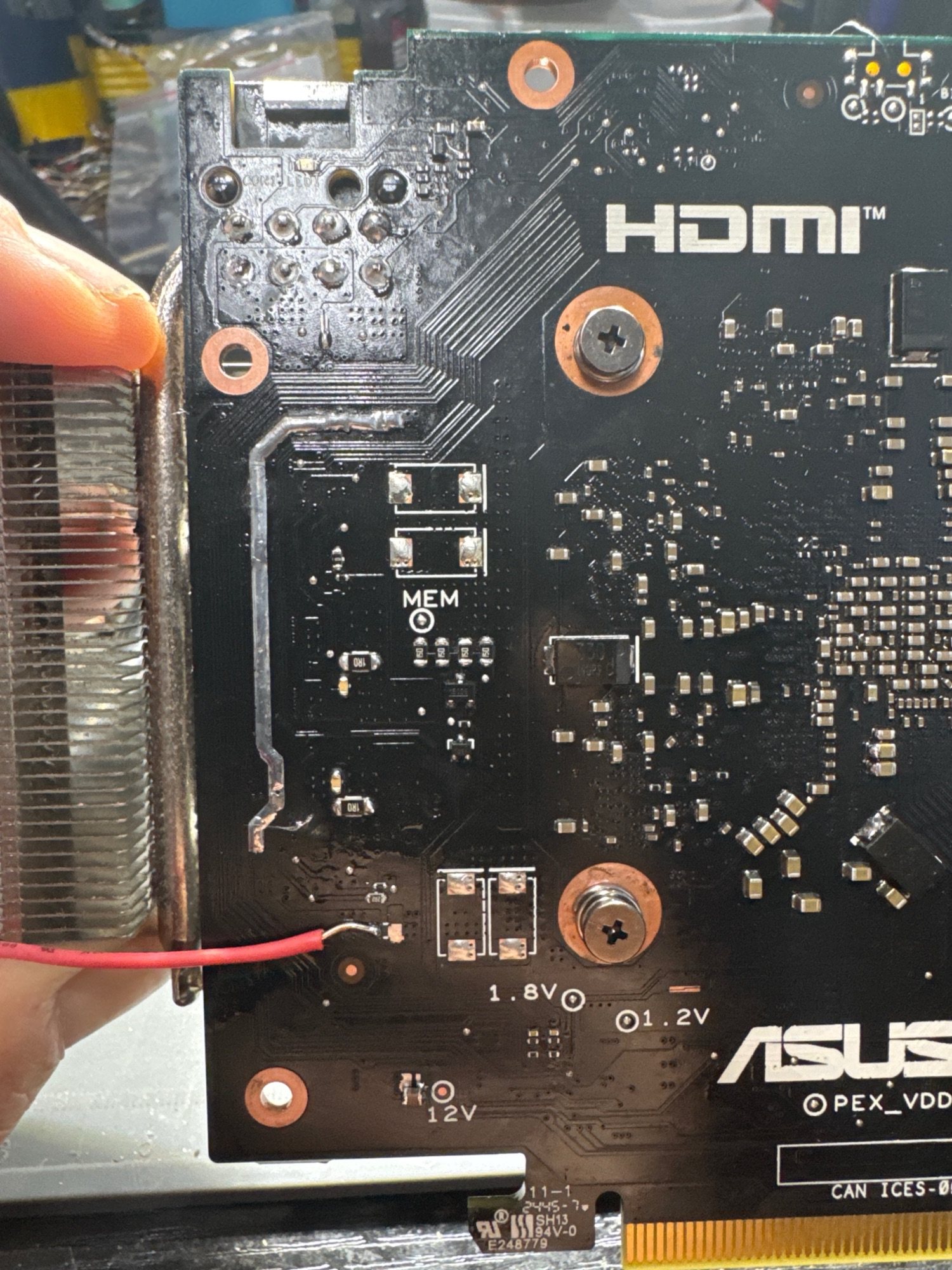
The obvious damage was on the back of the board, on the 12V distribution trace. That’s the copper path that carries 12V from the power input to the voltage regulator stages. A section of it had blown completely off the PCB. It’s a thick trace, built to carry a lot of current, but when the short hit, it acted like a fuse and burned open.
The heat did more than remove copper. The fiberglass underneath had carbonized, and carbonized PCB material conducts. It had created a new path from the trace area down to the ground plane underneath. There was also corrosion around the main PWM controller, a uPI uP9512S, and on resistors, capacitors, and other spots across the back of the board where the liquid had run.
Checking the rails at ASUS’s labeled test points
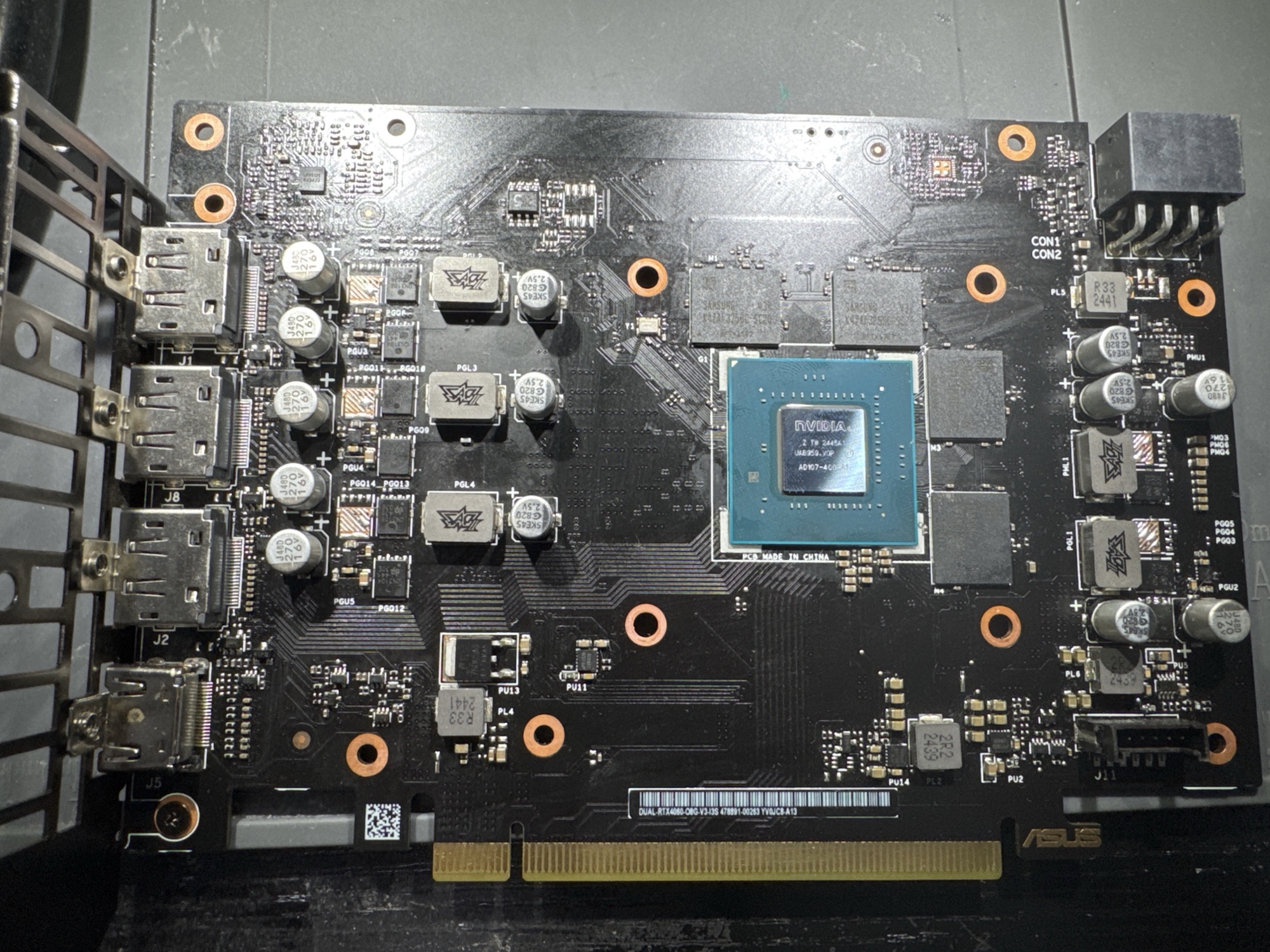
ASUS made this part easier than it is on a lot of cards. The Dual 4060 has labeled test points for all the important rails the GPU needs. That lets you measure every rail’s resistance to ground quickly and decide early whether the card is a good candidate for repair or a lost cause.

With the card unpowered, the readings were:
- 8-pin power input: normal resistance to ground. The 12V distribution net isn’t directly connected to the input line, so the input itself was clean.
- 12V distribution net: about 1.3 Ω to ground. On a healthy card this net reads in the tens of kilohms.
- GPU core rail: also about 1.3 Ω.
- Every other rail: normal.
The fact that the 12V net read exactly the same as the core rail was the key clue. A GPU core rail always reads low, around an ohm on a card like this, because the core is a huge low-voltage load. A 12V rail should never read like that. When two nets that should be completely separate measure the same, something is connecting them.
How a shorted high-side MOSFET ties 12V to the core
The GPU core is fed by a multiphase buck converter. On this card, each phase pairs a QN3106 high-side MOSFET with a QN3104 low-side MOSFET. The high-side FET has its drain on the 12V net and its source on the phase node, and the phase node goes through an inductor to the core rail. In normal operation, the high-side FET switches on and off very fast, and the output is the low core voltage, under about 1 V.
If that high-side FET fails shorted from drain to source, the 12V net connects straight to the phase node. Since the inductor’s DC resistance is nearly zero, the 12V net is now effectively connected to the core. That explains both readings. The 12V net measured 1.3 Ω because the meter was really measuring the core through the shorted FET. And at power-up, the full 12V rail would have been dumped into a chip designed for under a volt, which is why the supply shut down immediately.
The good news was the core itself. It read the same as a normal core rail, not lower, so the short hadn’t taken out the GPU.
Why voltage injection didn’t work on this one
Normally the fastest way to find a short is to inject voltage. You feed the shorted net from a current-limited bench supply, the failed part heats up, and a thermal camera, a film of isopropyl alcohol, or freeze spray shows you where.
That doesn’t work when the short connects to the GPU core. Anything injected into the 12V net goes straight through the shorted FET into the core. The core can’t safely see more than its normal operating voltage, so I couldn’t go above about 0.8 to 1 V. At that voltage, the core itself is a large load drawing current alongside the fault, so the heat spreads across the die and the large copper planes instead of concentrating in the failed part. Thermal camera, alcohol, and freeze spray all came up empty.
Finding it the slow way: one MOSFET at a time
With injection ruled out, I went back to the meter and tested each MOSFET in the regulator individually. One of the QN3106 high-side FETs in the core VRM was shorted.


With it removed, I measured the 12V distribution net again. It went from 1.3 Ω to between 30 and 50 kΩ, which is right where it should be. That confirmed the FET was the only short on the net and that nothing else downstream had failed with it.


The replacement MOSFET
The original part was a uPI QN3106M6N, a 30V N-channel fast-switching MOSFET in a 5×6 mm DFN package. I replaced it with an Alpha & Omega AON6512, which is also a 30V N-channel part in the same DFN 5×6 footprint.
The AON6512 is a heavier-duty part than the original. Its on-resistance is 1.7 mΩ maximum at 10 V gate drive, which is very low. The trade-off is gate charge: about 53 nC typical at 10 V, so the gate driver has to move more charge on every switching cycle. Whether a substitute like that is happy in a high-side position comes down to how it behaves under real, sustained load, and that’s what the overnight testing was for.

Rebuilding the traces
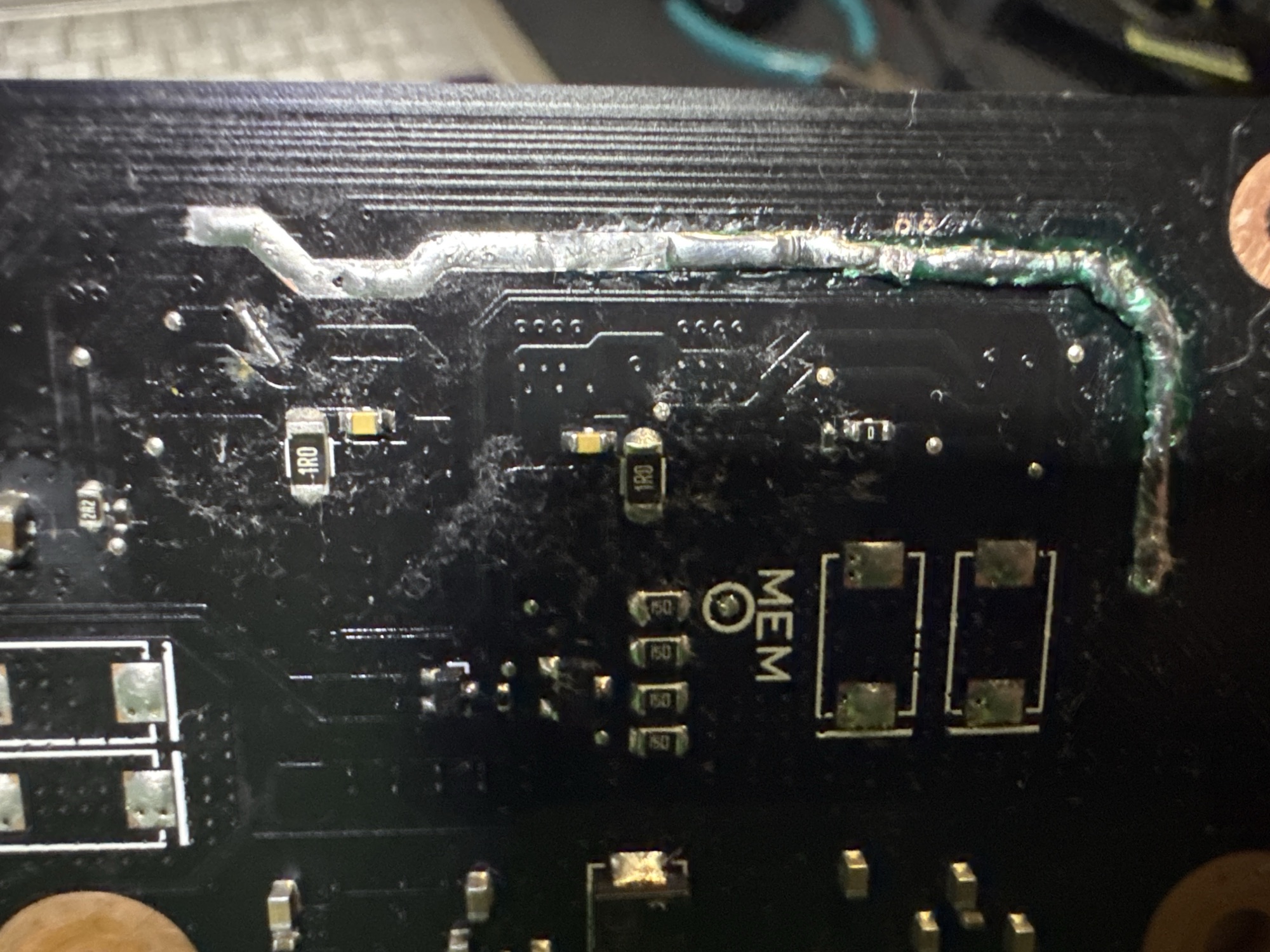
Before the blown trace could be rebuilt, the carbonized board had to come out. Carbon left behind keeps conducting, so a new trace laid over it would just short to ground again. I dug out the burned FR4 all the way down to the ground plane underneath, until the short to ground was gone.

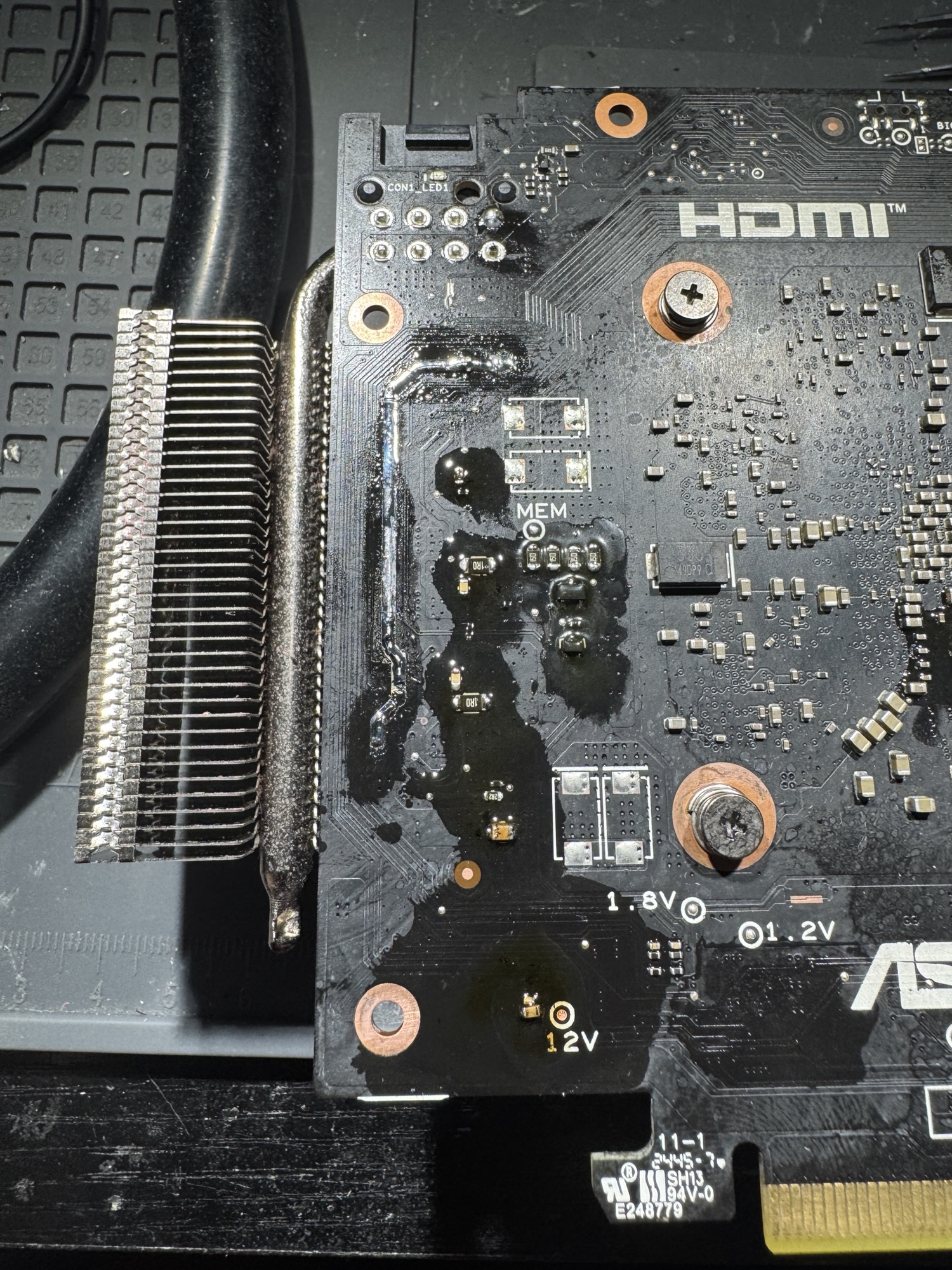
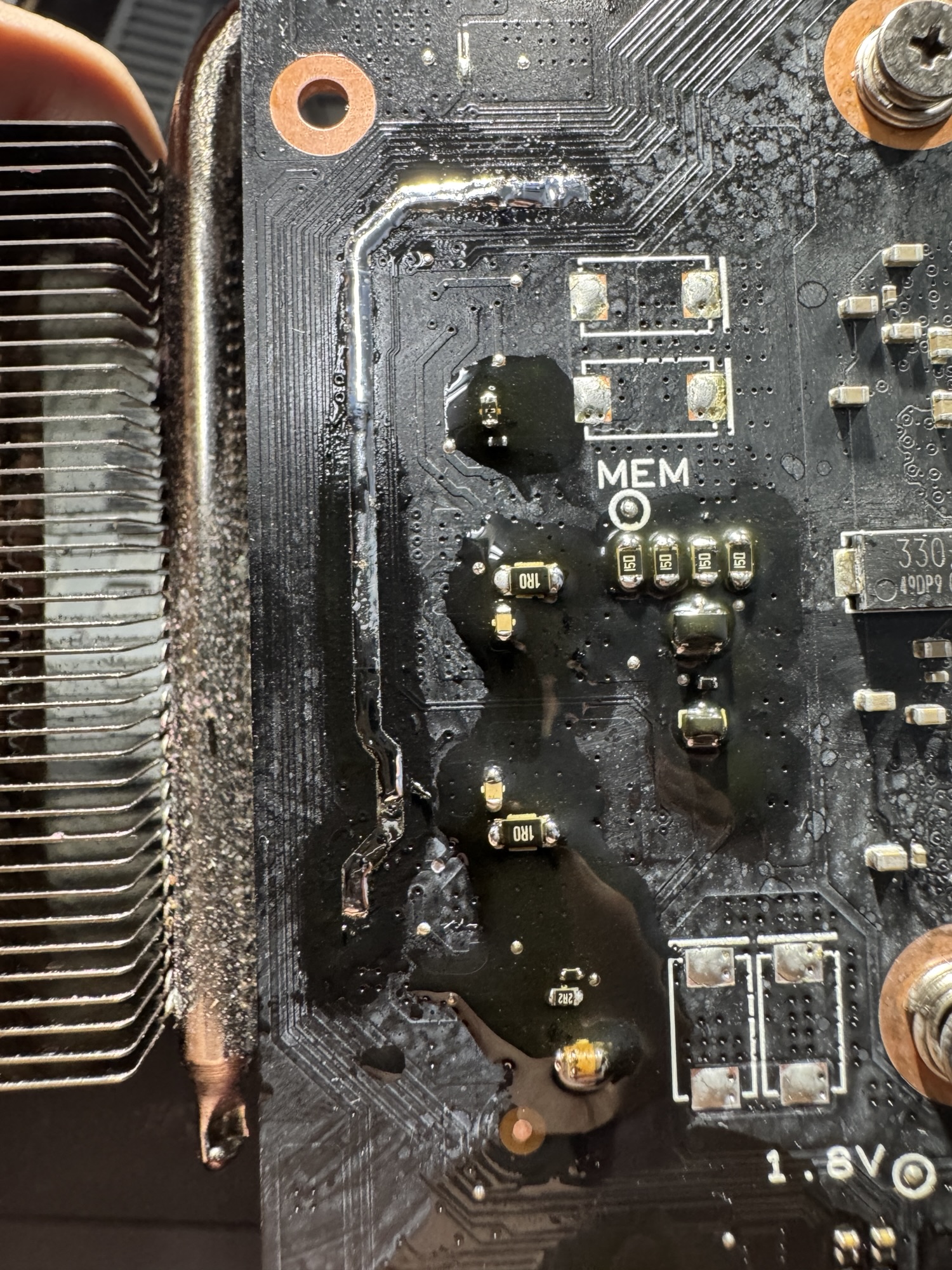
Digging that deep leaves bare ground plane exactly where the 12V trace has to run. So the exposed ground plane got a layer of UV-cured solder mask first, to insulate it. The new trace was built with copper tape laid on top of the cured mask and soldered completely along its length and to the remaining original copper at each end.


A second, smaller repair was needed nearby. A small test point on another trace had corroded and come off, which broke that trace’s connection to a via. I prepared and soldered both sides, then bridged them with enamel wire.

Capacitors and corrosion
Several 22 µF 0805 ceramic capacitors on the 12V net had taken water and looked bad, so I replaced them. Ceramic capacitors that have been wet and powered can develop leakage or cracks that don’t show up right away, and on an input rail that feeds the core VRM, that’s not something to leave in place.
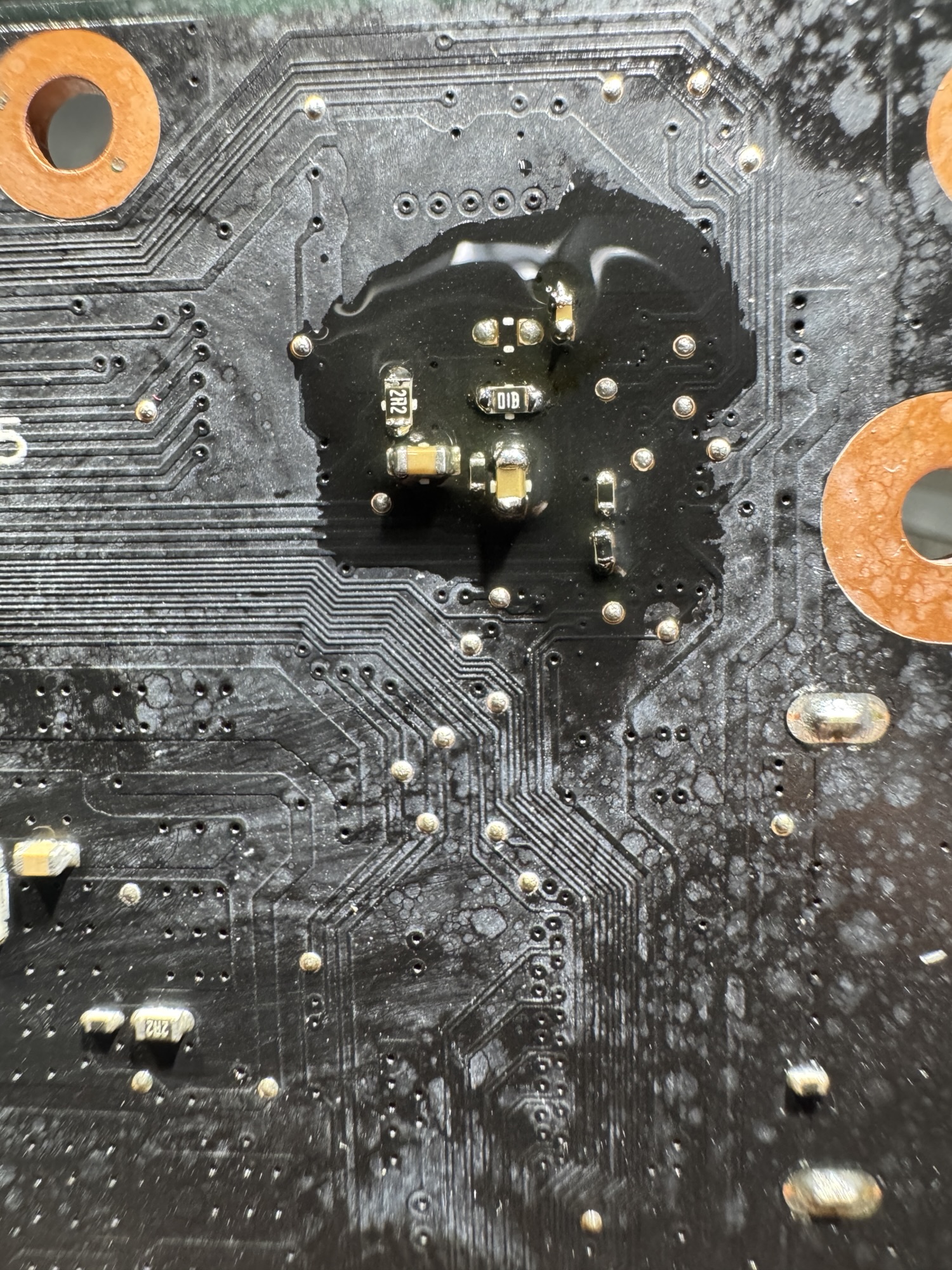
I cleaned the corrosion off the uP9512S PWM controller and off every spot the liquid had reached. Where parts had corrosion on their joints, I fluxed and resoldered them. Corrosion left on a board keeps working after the repair. It keeps eating at copper and can create leakage paths between fine-pitch pins, so it all has to come off.

Powering it back up
Before putting it in a PC, I put 12V on the repaired rail from a bench supply to make sure the short was really gone and nothing else was pulling current. It held, so the card went into a test PC. It came up and worked.
From there I ran FurMark and Unigine Superposition overnight. FurMark held steady at about 125 fps with no crashes, artifacts, or shutdowns. After the card had proven itself, I covered the two rebuilt traces with UV-cured solder mask and reassembled it.
The takeaway
A spill that kills a graphics card instantly looks catastrophic, but the damage is often concentrated in one place. On this card, a single shorted MOSFET and a burned trace were the whole failure, and the expensive part, the GPU core, survived. Labeled test points and a methodical resistance check showed early that it was worth repairing. When a short is tied to the core and voltage injection can’t be used safely, it comes down to patient testing, one part at a time.
Graphics card with liquid damage, or a PC that shuts off as soon as the card is installed? Circuit Surgeon does board-level GPU diagnosis and repair for customers in Oak Ridge and surrounding areas in East Tennessee, and by mail. Start a repair request or see how to ship your device.